Many couples still love each other, but the relationship they are living no longer resembles the relationship they intended to build.
They care about the marriage. Yet conversations create frustration, affection feels less natural, and neither understands why being together has become so difficult.
This was something I repeatedly encountered over twenty years of working with more than 1,000 couples in crisis.
Some had been together for twenty, thirty or forty years. One woman said, “We should know better.”
I understood her frustration. But my thought was: how could they know what no one had taught them?
Years together had given them a history. That did not necessarily mean they understood what their relationship needed or why their attempts to reconnect were falling short.
The 5Cs grew from my work trying to make that understandable.
Looking after a box called home
Many of these couples were putting enormous effort into things that genuinely mattered: children, careers, businesses, their home and financial security.
But much of that investment was reaching the life surrounding the marriage rather than the connection between the two people inside it.
They could become very good at looking after what I sometimes describe as a box called home. The household functioned, responsibilities were managed and life moved forward. Meanwhile, the couple could begin living more like colleagues than partners.
Part of what I noticed was a gradual change in identity.
Mum, Dad, provider, professional and business owner became the dominant ways of behaving. Partner and lover remained in name, but received less expression in everyday behaviour.
The problem was not parenting or professional success. These were effective success identities, but what makes good parent or business person is not what will make valuable intimate partner.
The skill sets are very different and this is why people are confused. Every where in life they are successful except at home.
One gentleman said he felt his wife treated him like a child his wife was with kids all day, in a separate session a wife in a session said her CEO husband comes home and delegates jobs for her to do, so she responds with “I’m not your bloody employee”.
The identities are efficient for the work they do, but in a relationship the same skills kill connection.
Communication was where the problem became visible
Couples often told me they could not communicate.
Yet many could explain their position extremely well. What they struggled with was recognising the meaning their partner attached to what they said.
A question intended to create reassurance could be heard as criticism. Silence could feel like rejection. A desire to talk could arrive as pressure.
Now each person was responding not only to the original issue, but also to what they believed the other person’s behaviour meant.
That led me to an important distinction:
Communication is not always where the problem starts. It is where the problem becomes visible.
More conversation could simply provide more opportunities to repeat the pattern. I wanted to help couples understand what happened within them, how they responded to each other and what those repeated exchanges were creating.
Five connected areas became increasingly important.
The five areas of marriage connection
CORE — How I relate to myself.
Who do I become under pressure, and does my behaviour reflect my values? Core concerns remaining connected to oneself while taking responsibility for how one participates in the relationship.
COMPASSION — How I care about my partner’s experience.
Their feelings can matter without being identical to mine or making complete sense to me. Compassion means making room for difference: care does not have to wait for perfect understanding.
CHEMISTRY — How romantic connection stays alive.
This concerns the attention given to presence, playfulness, affection and desire. It means creating room to be partners and lovers, while keeping intimacy an invitation rather than an obligation.
COMMUNICATION — How meaning is exchanged.
Is the meaning one person intends becoming the meaning the other receives? This includes checking rather than assuming, expressing needs constructively and repairing when words or behaviour cause hurt.
CLARITY — What we are building together.
Beyond responsibilities and shared history, is there a future both people have reasons to value? Clarity connects what matters to each person with the everyday choices that support their shared direction.
These are not five labels for deciding what is wrong with someone. They are five areas in which the relationship needs understanding and appropriate investment.
What changed my thinking was how they connected
The five areas were not operating independently.
Core could affect communication. Communication could affect compassion. Compassion could affect chemistry. Chemistry could affect how the future felt. And when the future lost meaning, willingness to invest could decline.
The relationship could begin reinforcing the very experience neither person wanted.
This is not a fixed sequence every couple follows. It explains why the visible difficulty is not always the whole explanation.
A couple worried about intimacy may first need to understand the pressure surrounding it. A couple arguing about their future may need to explore the values beneath their disagreement.
The framework gives us a way to examine those connections and find a useful starting point, rather than treating every difficulty as a communication problem or trying to address the entire relationship at once.
Investment is not simply more effort
Ultimately, the 5Cs brought me back to investment.
A person may be bringing the efficiency of a business owner into a moment that needs the presence of a partner. They may be giving what they would value themselves, without understanding why their partner experiences it differently.
The intention can be loving while the contribution misses what is needed.
The question is not only how much two people are putting into their marriage. It is what the relationship is receiving from the way they are investing.
The practical work is to examine specific moments, identify a more useful response and turn an intention into behaviour.
Valuing respect, for example, might become listening without interrupting. It has to become something that is practised, not simply a word someone uses to describe themselves.
Then we look at what happened. Was the commitment followed? How was it experienced? What still needs attention? Understanding matters, but so does what changes beyond the conversation.
This is not about finding someone to blame or asking one person to give endlessly. Understanding a pattern does not establish equal responsibility, and taking responsibility for a response does not excuse another person’s harmful choices.
My aim is to help couples understand what is happening clearly enough to make more deliberate choices about what comes next.
The 5Cs exist to make the hidden condition of a marriage more visible. They help couples examine who they are being, what they are investing in, and whether that investment is arriving in a way the other person can experience as love, care and connection.
Because two people can still love each other deeply while creating a relationship that no longer allows them to feel that love.
Begin with the Marriage Connection Assessment. It will help you reflect on the five areas, identify where your relationship may be under pressure, and decide what deserves closer attention.
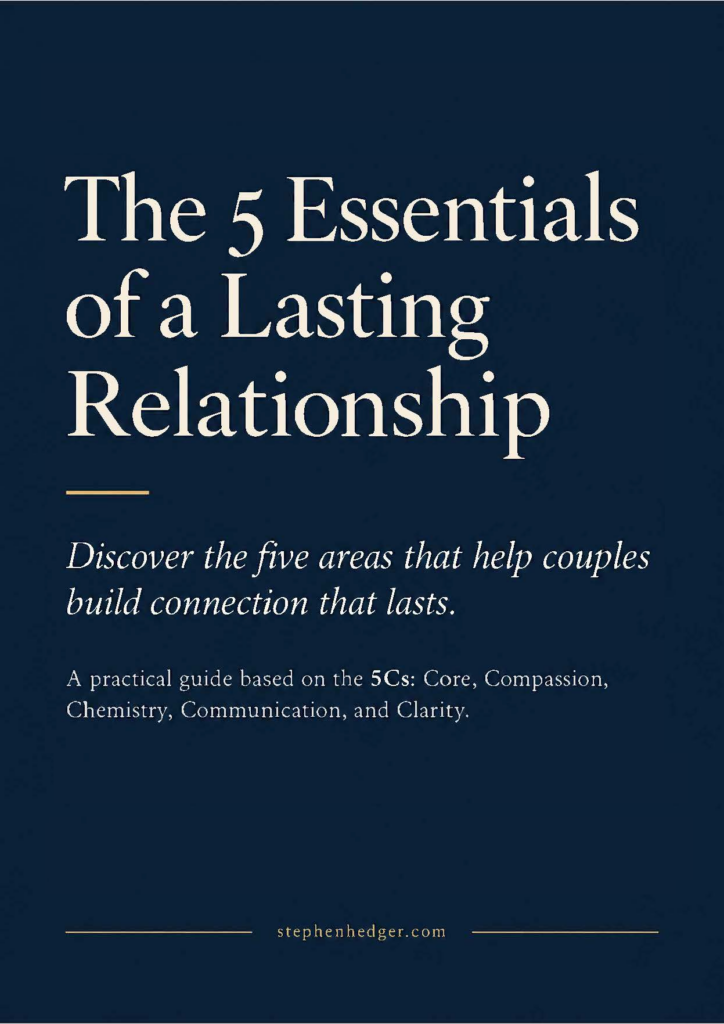
Plus you can download The 5 Essential of a Lasting Relationship FREE.

Harley Street Expert | Founder & High Performance Coach
With two decades of experience helping couples out of crisis, Stephen the founder of The Marriage Breakthrough Program, uses his proven system for rescuing and rebuilding relationships on the edge of divorce. A trusted advisor to CEOs, entrepreneurs, and industry leaders globally, his work blends emotional intelligence with strategic clarity. Known for navigating highly complex relationship challenges, Stephen helps individuals and couples find clarity and direction when everything is at stake.
Find out more >>> The Marriage Breakthrough Program
- Why I Created the 5Cs: The Hidden System Behind Marriage Crisis - September 18, 2026
- Your Marriage May Not Need More Effort. It May Need a Different Kind. - September 14, 2026
- 30 Behaviours That Can Create Emotional Disconnection in a Marriage - September 12, 2026