We know it’s going to happen again. We hate it, but it keeps happening. I’m tired of arguing.
Arguments, withdrawal, stonewalling, blaming, bickering—it’s exhausting!
“We’re not able to talk without rowing – Every conversation turns into an argument with my wife.”
“We literally can’t have a conversation about anything at all without it ending in an argument – Every conversation turns into an argument with my husband.”
Those were clients’ actual words to me.
So many couples are saying the same thing. They end up either in some form of conflict, not talking, or only talking about what is safe. But safe is not really connecting; it’s transactional, and years of this are not safe for them either.
Loss of connection stacks resentments. As they stack, the pleasure in the marriage reduces and now they become someone who turns every conversation into an argument
A lot of advice will talk about attacking the issue, not the person, not bringing up the past, and using “I” statements. Whilst this advice makes sense, in an intimate relationship that is struggling, there are deeper layers to consider.
Why is talking to each other so difficult?
The first problem couples don’t see is how different their partner is from them in terms of why they speak.
What is their reason for speaking?
Have you ever considered this as a question?
Not everyone speaks for the same reason. They may have very different goals in mind, and not knowing this will cause all manner of problems.
For illustration purposes, I’m going to create two camps. Some people live in both camps, depending on the context.
- The Connection Camp
- The Solution Camp
If you are a “connection person” trying to speak to a “solution person”, or vice versa, you are not going to get through if you keep speaking only in your own language pattern. In fact, you are likely to confuse and alienate them.
Look at this example.
The connection person tends to want to fill up emotionally through sharing and connecting with others; it’s their oxygen. The solution person simply wants to solve it, let it go quickly and move on.
So when the connection person presents a problem, they want to connect, share and know they are not alone. To the solution person, this makes no sense.
Their thinking is: You’ve had a bad time. You didn’t enjoy it the first time, and now you want to relive it over and over.
To stop the problem growing, the solution person might say, “You don’t want to worry about that,” and then offer a solution.
The solution person is feeling great because they have solved the problem for their partner, but is then in utter dismay as the connection person erupts, upset at not feeling heard or cared for.
The solution person will usually withdraw or become frustrated. If this happens too many times, they may decide that conversations are unsafe and eventually refuse to engage.
If the connection person tries to connect more by shouting, repeating or sharing more, this can overwhelm the solution person.
The solution person can feel like a failure, unloved, disrespected and unappreciated.
The connection person can feel alone, abandoned, unloved and unsafe.
The way the solution person demonstrates love and support, in their mind, is through their ability to fix things. Their partner wants them to come out of the solution zone and connect, and can’t understand why they don’t.
The solution partner wants the connection partner to stop being so emotional and stick to the point.
This mismatch in conversational missions confuses each person. They attach a meaning to it that usually leads to self-protection.
The sad reality for these couples is that both people are protecting themselves from a partner who, in the beginning, is not trying to hurt them at all.
Imagine 20 years of this.
The good news is that communication in an intimate relationship is a learnable skill. But your partner will not naturally know how to speak your language.
The simple problem compounds
This is the second hidden problem. A conversation starts with one problem. But when the couple cannot process it together and no repair happens, it changes the condition of the marriage.
It’s no longer about the initial issue; it’s about what was said and how it was said.
The challenge they face now is how ineffective they are at processing their problems.
The diagram below shows one person wanting to be understood—that is the initial FOCUS. When the PROBLEM is managed badly between them, no repair happens. The resulting CONDITION is one in which more problems have been created by this ineffective process.
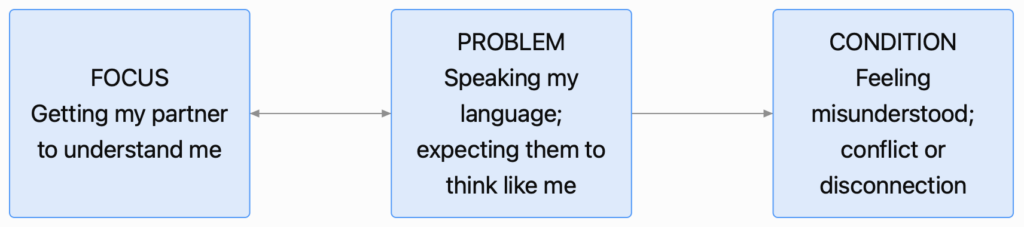
In simple terms, one problem discussed badly can result in many more problems being created.
Your partner’s needs are different from yours
This is the third hidden problem. Much of what people argue about is unmet expectations or needs, and this also shows up in how they communicate.
People driven by different needs communicate from the perspective of those needs. What drives them and what matters to them are different too, but many are unaware of this.
It’s almost as though people are operating on the belief: “If you don’t think like me, you don’t love me,” or, “If you don’t think like me, you are wrong.”
And then there is the expectation that their partner should just know what they need because it’s obvious to them.
To you, it’s obvious. But partners are not mind readers. Expecting this sets them up to fail, which isn’t very loving.
In sessions, clients often discover that they are unaware of what they need themselves; they only know when their needs are not met.
What can you do differently?
When you communicate and your partner doesn’t respond the way you wanted, I want you to take a breath and think:
- Did I communicate with them in my language or theirs?
- Have I understood my own needs well enough and communicated them?
- Have I demonstrated that my partner’s needs matter to me?
The irony of this problem is that if you want to be understood, you have to understand your partner, so you can communicate in a way they can connect to.
You can shout, repeat yourself or say it more slowly, but unless it’s in their language, you may simply shut them down or activate their frustration.
What my clients learn is that your communication must set your partner up to be successful with you. You are supposed to be a team, so help them.
I see so many people put their partner down for not understanding them, only to realise that they don’t understand their partner or themselves either.
You are not necessarily failing to communicate because one of you is a bad communicator. You may be speaking from your own nature and expecting your partner to receive it as though they share the same nature as you.
The answer is not simply to talk more, repeat yourself or find better words. The first step is understanding the critical differences that shape how each of you speaks, listens, needs and responds.
If you recognise your marriage here, the next step is to understand how this is happening between the two of you.
In my private Marriage Breakthrough Program, I help you uncover the differences driving your conflict, recognise how your attempts to resolve it may be pushing you further apart, and learn what to do differently in the moments that matter.
Apply for a Private Marriage Crisis Call

Harley Street Expert | Founder & High Performance Coach
With two decades of experience helping couples out of crisis, Stephen the founder of The Marriage Breakthrough Program, uses his proven system for rescuing and rebuilding relationships on the edge of divorce. A trusted advisor to CEOs, entrepreneurs, and industry leaders globally, his work blends emotional intelligence with strategic clarity. Known for navigating highly complex relationship challenges, Stephen helps individuals and couples find clarity and direction when everything is at stake.
Find out more >>> The Marriage Breakthrough Program
- Marriage in Crisis? Are You Wasting Your Time Trying to Save Your Marriage? - November 6, 2026
- Case Study: By the Time She Contacted Me, She Was Already Planning Their Separation and Divorce - November 3, 2026
- How to Talk to Each Other—Without It Turning Into Another Argument - October 29, 2026